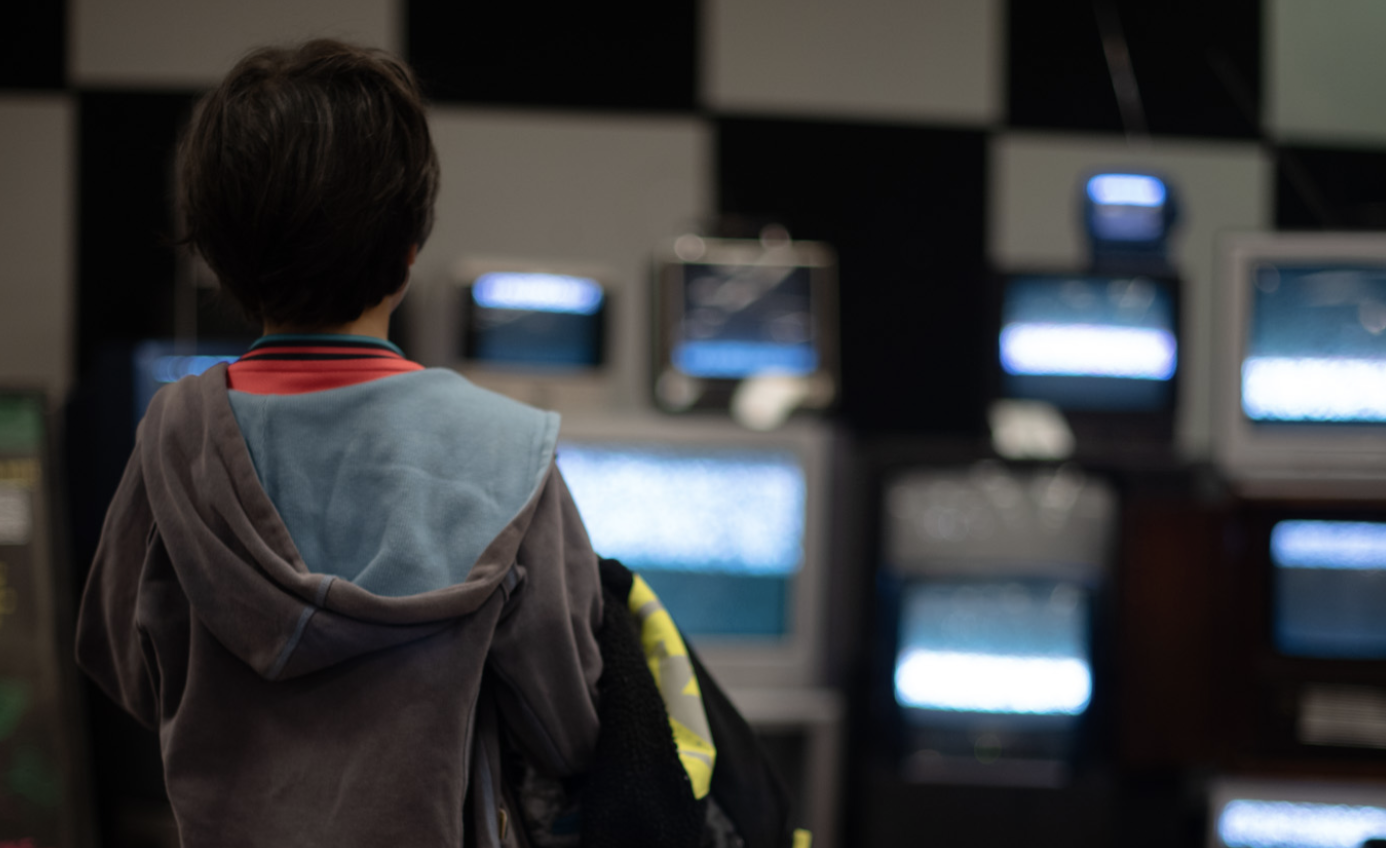
Have you ever wondered what it would feel like to step inside an ADHD mind? That’s exactly what Alex Yagilowich and fellow Creator, Andrew Rayner set out to demonstrate, with their TV-screen based exhibition at the Loko Club in Bristol.
Alex wanted to present how it feels to be inside an ADHD brain, giving participants the opportunity to really understand and appreciate how it physically feels, allowing them to gain greater knowledge and understanding as to how a neurodivergent person deals with life.
“What does your ADHD brain look, feel, or sound like?”
Alex chose to create her exhibition to reflect her experiences of what it is like to have ADHD, so she reached out to 80 people with ADHD to gather how their mind looks, feels, and sounds like, for them.
Alex created 2-minute videos from all of the responses, as well as voice responses that people could listen to on the phone during the exhibition. Alex found that she could relate to many of the responses, especially when they described their minds as being like a fly that flies all around them. Alex also related to the anxiety others struggle with, but for the first time in her life, she felt like she could talk about having ADHD openly and unapologetically, and she believes there is a big awakening and acceptance in society now.
An Interior Designer and Educator, turned Interactive Architect and Maker, Alex grew up in the suburbs of New York and was diagnosed with ADHD when she was 18. Not only does she create multi-sensory educational exhibitions, she also does Site Design, Interaction Design, Stage Design and Interior Architecture. You can find out more on Alex’s website https://ayagilowich.com/exhibitions.
My brain looks like windows 95, looks like chaos, feels like fireworks. My brain feels like a dog, constantly chasing its tail that constantly goes around and around and is distracted only by cake.
Growing up, Alex’s teachers knew she had attention difficulties, but she was not diagnosed with ADHD until she started university. Then in 2020, she noticed other people were starting to get diagnosed and understand themselves, which helped Alex to feel seen and understood within her community. For her whole life, Alex had felt that having ADHD was something that needed to be hidden, and as it was not widely accepted and understood, she did not have a lot of support, so felt it was better to hide herself, which left Alex feeling drained and misunderstood.
When starting work, Alex felt there was an unconscious bias from employers, and she felt like many did not understand her, and she did not want to be seen as being less capable than others, so she continued to hide her true self.
During a challenging time whilst studying in University, Alex’s friend encouraged her to talk openly about her ADHD diagnosis to her lecturer, which resulted in Alex becoming more comfortable and open about having ADHD. Alex was concerned that as the general feeling in society about having ADHD, and the issues that this may bring, was seen as being just an excuse for poor time keeping and not being able to sit still, which then led on to inspire her to name her exhibition, ‘Not Just an Excuse’.
Take the TV brain, amplify it, and make it bigger, that was the definition, but I wanted it to be told by people like me.
Alex explained that ADHD seems to be the definition that neurotypical people have put onto people with ADHD as a way that bothers them/effects them, the name itself seems very negative. For Alex, having ADHD feels like a bunny that hops constantly, in and out of different places and it does not stop. She struggled to sleep throughout her life, so started to take medication when and with trial and error with doses, she found this was beneficial to her at times.
After the success of The Attention Machine Experience, Alex hopes to evolve the exhibition to include an interactive element, with the use of remote controls, putting all of the TV channels on at the same time, designed to represent the ADHD super power; hyper focusing, which are designed to change when they get bored. It is being created to be a group experience, to try to create hyper focus, which could prove very difficult for the participants.
Alex described the upcoming exhibition as being like a giant rubix cube, relying on group participants to really concentrate and focus to try to work it out. The first exhibition is planned to start in Bristol and then it will go on tour after that.
“If you judge a fish by its ability to climb up a tree, it will forever believe it is stupid. We are told we are dumb and stupid our whole lives, we just need to find our water. Hopefully you will find yours and I’m sure you will.”
As a society, there are now things put in place to support people with ADHD, where there wasn’t before. She understands that people are now prepared to make reasonable adjustments for the neurodivergent community, but more work can be done. She hopes her artwork can continue to challenge people’s views on people with ADHD and help to give society empathy and a true insight into the reality of having ADHD.
Since being open about her ADHD, she feels better than ever. “I finally feel seen and heard within society, and for the first time, I can be open about having ADHD. I can now say I am part of a community.”
Alex wishes that people told her when her was growing up, that it doesn’t matter what you do, you can do so many different jobs. People with ADHD are able to jump into new things head on and pick up skills quickly, and trust that you will be able to pick up anything that is put in front of you.
She became a designer and an educator and never thought she would find the thing that she truly loved to do. But when she teaches, she feels like she is at her best and she has been put on this earth to teach, and she hopes that each and every one of you finds that one special interest that makes you happy too.
To experience this sensory stimulating neurodivergent exhibition online, visit: Not Just an Excuse – The Attention Machine Experience: Loco Klub.